
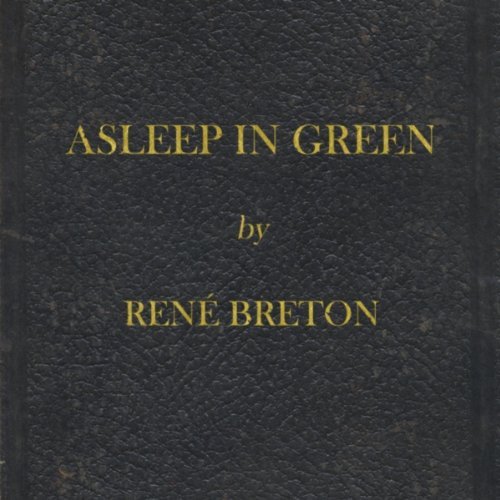
 Heavy in mood and lyric, René Breton by all accounts was meant to be a pseudonym for Ryan Hurtgen and Tobin Sio’s current project in order to free up lyrical ideas and explore free form poetry that took the band in a whole new direction. Now René Breton is an album, a book and a band.
Asleep in Green, Fifth Ace Records LLC, is as much sharing of how Iridium was discovered to Botswana folk tales and answering the big “why am I here?” type questions.
“I often feel like this Thing that is a huge waste of time, asking questions with no answers, wondering how I fit into the universe.”- (Asleep in Green, Page 2)
The book acts as a framework while listening to the music. Each chapter covering the song topic in what may be a cross between Allen Ginsburg and a college guide to advanced philosophy. This was the brainchild of Ryan Hurtgen’s muse in all things art, from words to drawings to arrangements.

Ryan Hurtgen / Photo- Jamie McCormick - courtesy briterevolution.com
Tobin Sio, who has worked with Ryan for several years as percussionist, engineer and studio gear head, makes for great team work. The collaboration between recording, printing, and publishing a dynamic original score took the team to a new level when Nicole Taher discovered their work and the three formed Fifth Ace Records.
When heard live, René Breton as a four piece band almost seems symphonic and works well whether at Mercy Lounge or The Frist Gallery as an art installation. Even though the two groups are not similar in content, René Breton moves the senses much like The Velvet Underground with Andy Warhol’s Factory turning music into art and art becoming the medium of delivery.
Ryan, singer/songwriter, is somewhere between an intellectual Syd Barrett and the man that Jimmy Page wanted for his new band that would be Led Zeppelin, Terry Reid, a sixties British icon, who turned down the gig and told Jimmy Page to check out Robert Plant, a great singer with Band of Joy. That is Rock and Roll History. The Raconteurs did a spot-on version of “Rich Kid’s Blues.” Pure Terry Reid. Ryan’s voice fits that range more than his contemporaries in Coldplay or Radiohead.
Sitting down with some herbal tea in East Nashville, we began a conversation that could go just about anywhere.
Tobin Sio: The music was pretty much worked out in our practice space and there wasn’t whole lot of demoing going on, we had a whole lot of ideas of songs we wanted to do.
Brad Hardisty/ The Nashville Bridge: Where did you record at?
Tobin (Toby) Sio: It was at a studio that is no longer there called Kosmodrome (Mike Lattrell). It was right on Music Row.
BH/TNB: When I listen to it, I hear this great quality.
TS: I went to school for Engineering.
BH/TNB: Were you playing with different people at the time?
Ryan Hurtgen: We were playing in a couple of bands with Gabriel Golden and Ross Beach.
BH/TNB: I know you went through a couple of name changes, what were you called during Next Big Nashville?
RH: The first band was called Telephant. Then we wanted to change the project name because we were never really with that. I was writing under the pen name René Breton.
BH/TNB: So René Breton was kind of like your “Ramone” name?
RH: It was more like Mark Twain. I was just using it just for the writing. We were like we need to come up with a name and we were just going to put René Breton on the book of short stories with the music. The name is taken from two French Authors René Char and André Breton. We had the cover figured out and we didn’t know if it was going to have Telephant on it but it looked better as Asleep in Green by René Breton.
TS: We get people who come up after the show and say, “Who’s René?” and we’re like we are all kind of René.
RH: We actually played a gig in Birmingham and there were people there that were like I was expecting to see a hot blond chick with an acoustic. Anyway, we recorded with Donny Boutwell at Kosmodrome, he’s from Texas.

Tobin "Toby Sio" / Photo, Jamie McCormick - courtesy briterevolution.com
TS: Donny is an equally good Producer and Engineer as well as a drummer; he had a ton of drums around the studio. I thought this is great, we are going to have good drum sounds and I’ll be able to use them.
RH: That’s how we were able to record there; I was helping at the time to build the studio. Donny gave us the key at night so we recorded most of the record at night time from about nine o’clock to four AM.
TS: We tracked for a long time, it was a long process. Over a long time when Gabe or when somebody was available and we could align schedules.
RH: We had a portable hard drive and we did the entire piano at Grand Vista on a Steinway.
BH/TNB: I guess good piano is a real key to your sound.
RH: Yeah, then Donny introduced us to David Henry who did the strings.
TS: He arranged all the parts and recorded them. We gave him the charts and he would do a Pro Tools session and we would get them back and we were completely blown away, it was amazing.
BH/TNB: How long have you guys been here in Nashville?
TS: I moved here in ’01 to go to the MTSU Recording program and I officially moved to Nashville in 2005.
RH: I moved here at the end of ’06.
BH/TNB: Were you coming out of school when you moved here?
RH: Yeah, I graduated in ’05. I went to the University of Missouri. I’m from St. Louis.
BH/TNB: There is a little bit of a music scene in Columbia, Missouri.
RH: Definitely a little Screamo and a lot of anarchists that live there. A lot of hippie bands, jam bands. Like Phish more than Widespread Panic.
BH/TNB: When did you start teaming and writing together?
TS: We actually worked at a restaurant together. Ryan was a waiter and I was a busboy there. This is in ’05. I know it was ’05. There is another side story because Ryan came to record in Nashville in 2002.
RH: That was a solo thing. I was making records on a four track in Columbia, Missouri and some people got a hold of it in Nashville and wanted to do a record so they brought me down. Steve Wilson, Donny Boutwell, that’s how I met Donny Boutwell. When I came back, I met a girl who knew Donny Boutwell and I said I knew Donny Boutwell and she said, “well come by the studio and say Hi!” so I did. I said, “What can I do to get you to record me?” He said he needed a lot of help around the studio and I said “I’m there.”
TS: Before it was a studio, it was just one of those offices on the second floor of one of those Music Row houses so they just completely tore it out, built new floors, made it all acoustically right. Ryan helped out on that. Ryan gave me his record when we worked at the restaurant and I listened to it. I was like this is awesome, we should play together. That’s how we started playing together.
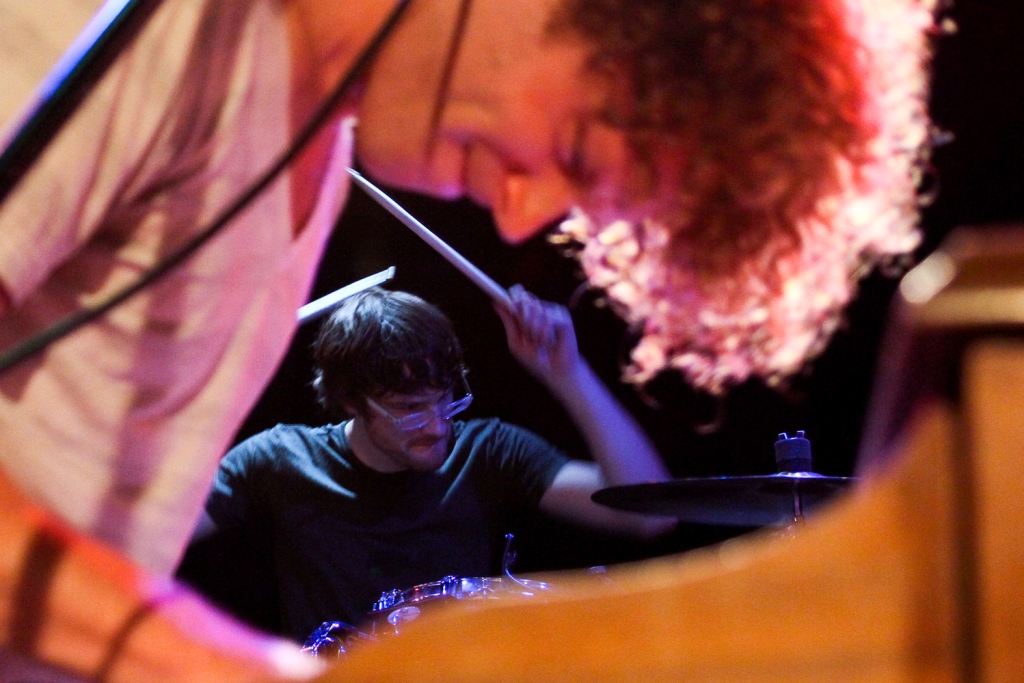
René Breton live at The Rutledge / Photo, Jamie McCormick - courtesy briterevolution.com
RH: We partnered together to get the funding to put the project together. Nicole Taher comes from the Publishing world, she had worked with Ron Fair (Record Executive, Music Producer)
BH/TNB: Are you trying to get into the music business L.A. thing, film?
RH: It’s such a changing industry. We have been just going the independent route with hopes of getting a deal, signing with the right group. We distribute ourselves. We’re online.
BH/TNB: It looks like you are doing pretty well with the book concept.
TS: Yeah, the book is doing surprisingly well.
RH: I’m actually surprised how many we are selling because it is quite expensive. I think people want something they can take home. It’s a tangible product that you want to have.
TS: Not just a CD in a jewel case like one of the CD’s you throw on your bed.
RH: Plus it’s interactive; it’s one of the things I wanted to do.
BH/TNB: I look at it and I see philosophy, folk stories as well as your own artwork. It’s kind of all encompassing.
RH: It’s kind of the thing that inspired me. I’m not a really great musician but I can write a pretty good song. I think being a good artist is being an artist in all kinds of areas. The guys that I admire have come from that kind of background like Leonard Cohen, David Bowie, and Bob Dylan to a certain extent to. It is about being well rounded, into writing, reading, the higher road, the voice of my culture.
BH/TNB: What are your influences musically?
TS: The tracks were a natural groove, no click track, my schooling in music had the influence on my training, and I did the high school jazz training. All my drum teachers were old jazz guys. If I had to choose a rock drummer it would be Brad Wilk from Rage Against The Machine because I love his grooves and they’re so powerful, not super flashy, just groove. Also Chad Sexton (311) , he has always been amazing as well as Jeff Hamilton.
BH/TNB: What kind of drum set do you use?
TS: I built my own set. I got the idea from a friend jamming down on Lower Broad (Broadway, Honky Tonks). You choose your own shells; everything and they just drill the holes for you. We have been into making our own instruments. We tore out the guts of the piano and put our own keyboard in there.
RH: You want to have a stage presence of what your stuff looks like. We decided, let’s just have cool instruments. Make it about the music, but the instruments can look good.
BH/TNB: Your music is very visual.

At The Rutledge, Nashville / Photo, Jamie McCormick - courtesy briterevolution.com
RH: It is visual, it’s performance and people want to be entertained.
BH/TNB: As far as songwriting?
RH: I play the ukulele. It’s very useful.
BH/TNB: George Harrison used to write on ukulele, and then he would expand on it.
RH: It’s kind of like those songwriters in Nashville that have the first three frets than nothing. It’s simple chords, that’s sometimes how you get to the real bones of a song.
BH/TNB: Lets’ get to the ideas on these songs. Were you studying Philosophers?
RH: I studied Philosophy in College. It’s interesting how this came about because my intentions when I first moved to Nashville were that I wanted to be more of a political artist.
BH/TNB: Kind of like a Tom Morello (Guitarist/Activist) but more folk style?
RH: More like a Phil Ochs. I was really pissed off at the wars and everything. I realized that my opinions were changing and then I realized I wasn’t sure if I agreed with everything I was saying. I said to myself, I need to get into something different; try to do something based more on artistic ideas about humanity, whereas that includes politics but it’s more about the big picture, what love is. I was reading this book at the time called “The Theory of Everything” by Stephen Hawking. He references another theory by Clare W. Graves and it’s called “Spiral Dynamics.” It looks at humankind in these things that are called “Memes” (systems of core values or collective intelligences, applicable to both individuals and entire cultures)”. There is first tier thinking, second tier thinking, all about consciousness. People fall into certain categories in certain areas of their lives. In the green Memes, everybody feels everything needs to be Democracy, everything should be fair, everybody should have an equal say, but, in actuality, they fight with the people in the red Memes that says that people are not equal and you need to conquer people because they can’t take care of themselves.
That is just one aspect; it goes into everything whether it’s love, family or how man relates to nature. At the time I was reading this book, I thought I’d really like to make an album that had every one of these Memes as a song. At the time I met a guy who was a dancer at the Nashville Ballet and we started working on this idea about writing about it. We started working on it at The Nashville Ballet. We had like ten people involved. It was kind of a failure.
BH/TNB: Yes, but sometimes one thing turns into another.
RH: That’s exactly what happened. The ideas I was constructing for this Ballet turned into some of the songs on this album. That morphed into some other songs as the need arised. I was reading about the Surrealists and their methods like Manifestos.
BH/TNB: So what started the process?
RH: I did paintings. There were not any rough sketches or anything. I would just do it. The aspect of “Automatic Writing” had to do with the songs. Playing a guitar and then just saying whatever I was thinking. Start off with something automatic like “I’m sailing”, then you had to keep that.
BH/TNB: Kind of like a Mantra.
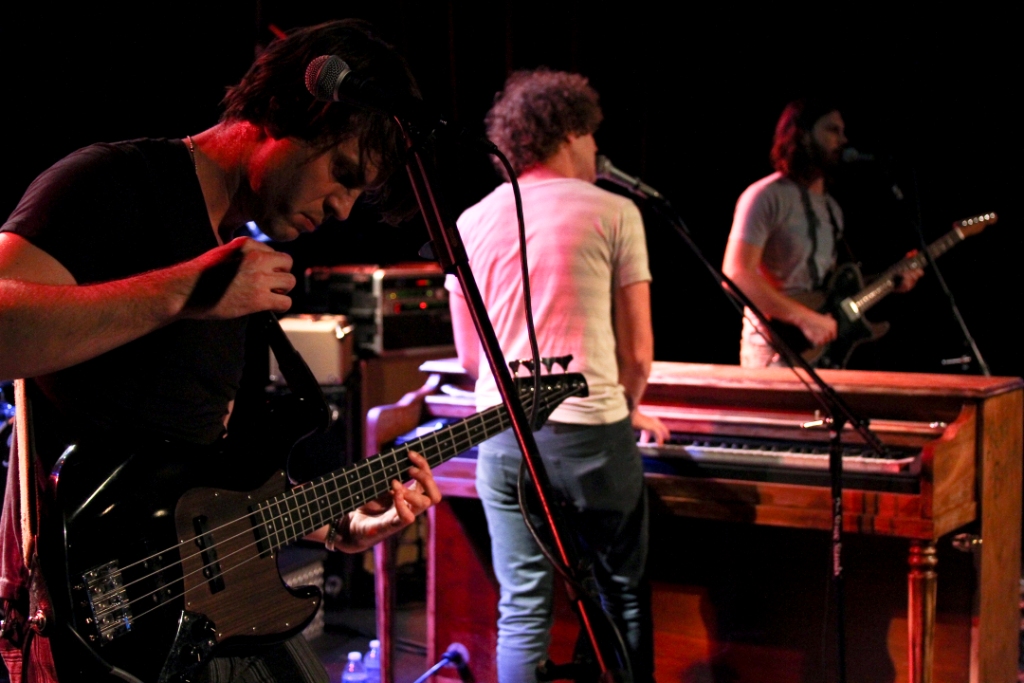
On stage with the full band / Photo, Jamie McCormick - courtesy briterevolution.com
RH: A lot of times like “Botswana”, I had to go back and re-write them so they made more sense. It can make sense. It should make sense and they do make sense.
BH/TNB: It’s more of a “thinking” person’s music.
RH: I’m not saying that is always going to be my method. That is what this project was. Right now, the stuff I am working on is the complete opposite. It’s very crafted.
BH/TNB: What about “Anne Frank”. What made you think about writing about her?
RH: I was down at The Nashville Library. One day I came across The Diary of Anne Frank and I started reading it. I thought at the time, this had a feeling about it. I could write a song about isolation in the modern world and base it around the idea of Anne Frank. It’s not about being forced into isolation. It’s about choosing it. How we can create our own little prisons around ourselves. The idea is from a story about a Japanese girl named “Hikikomori” which translates into “withdrawn youth”. It’s these kids who get into their computers and they don’t leave their rooms. They can’t get out.
BH/TNB: Like extreme geekism?
RH: Exactly. It’s like a national problem in Japan.
TS: There are government sponsored boot camps in Japan for youth addicted to the internet.
RH: This is something that has never existed in the history of mankind. That’s where the original name of the band came from Telephant. It was the idea of global culture. How is man really changing because we are so connected to each other? Our attention span is getting shorter. We are constantly getting bombarded with information and it is really affecting us.
BH/TNB: It’s like a couple of years ago; you’d get going with texts with a girl and after a while it was just ridiculous, no verbal communication.
RH: Yes, but now it’s the norm.
TS: It’s de-personalizing. I try to make a point of writing letters now. I have a typewriter from the 1930’s and I’ll sit down and write a letter.
RH: You get that with a Bob Dylan tune.
BH/TNB: Yes, society is all becoming vaporware, like how long is it going to last?
RH: That’s it. A letter you can save. I guess you can save a text of whatever but are you really saving it? Who does?
TS: My Grandparents don’t have e-mail so I have to write them a letter anyway.
BH/TNB: Okay, so there are four aces in a deck what does the fifth ace mean?
RH: The fifth ace represents the unanswered question which we all hope we know like the idea of God or religion. It represents the answers to our unanswered questions. The anchor is important because it represents being stable. It’s like I write in the book, “I’m looking for the fifth ace in order to anchor me.”
BH/TNB: Here was something that made me think from the book, “Dreams are twisted versions of everything that is real in your life.”
RH: Yeah, you wake up thinking, what does this mean?
BH/TNB: Let’s talk about “Botswana”.
RH: I really like that. That song really came out of the idea of automatic writing. All of a sudden I blurted out Botswana. I thought, what about Botswana? Then I went back and did all this research about Botswana. I investigated and found these cultural stories of Botswana being where life began. That is what is going on throughout the album. Like the idea of man being found in the rock of Gibraltar. Gibraltar means the stronghold from where he would rule the world. The rock of Gibraltar was that fortress that gave you passage into the Mediterranean. Getting back to Botswana, I thought this country has the highest AIDS rate. That’s an interesting fact. I’m getting ecstatically red, thinking that is weird but let’s go with it. Trust it. I found the folk story and I thought I needed to reference the folk story. A lot of the stories in the book are like that. They start out with a thesis and they tie back in a different way. It’s a lot like a dream. It comes with a certain idea and then you go back and interpret it and it ties in with something else. Like when you have a waterfall in your dream. What does that mean? Am I in danger? Am I about to lose my job? Am I about to fall off? Maybe I’m about to be freed, on top of the world and everything is flowing by naturally. It’s all this idea of abstraction that I wanted to get.
BH/TNB: Okay how about Robespierre? The line, “One day I was approached with the opportunity to cheat and steal.” Is that a true story?
RH: No, I became a character. Robespierre was a French revolutionary. He took the Jacobins to oust the King. Soon he realized the power he looked to overthrow, he was becoming himself.
BH/TNB: So, he became what he disliked?
RH: Exactly, the story brings it to a new age and the character is not Robespierre, it can be whomever or whatever you want.
BH/TNB: So what’s next?
RH: I’ll be moving to L.A.
BH/TNB: Will it be René Breton?
RH: Yes.
TS: Ryan will be going first and then I’ll be out there in a few months.
RH: We will be starting on a new René Breton project. It won’t be about dreams or psychedelia. It will be a lot more grounded. It will be about well crafted songs. I’m ready to go. I have been in Nashville for six years.
BH/TNB: You’re leaving when things are really starting to change for the Indie thing. It really has only been the last two years that things have really changed in Nashville.
RH: It has and I have really thought about that. I never really got into a “scene”; I spent a lot of time writing. It’s really about just getting into a different city. Asleep in Green is this city, Nashville’s project. I need to get into a different place. Different cities give you different vibes. You read about different things. You are around different people. It’s time for change.
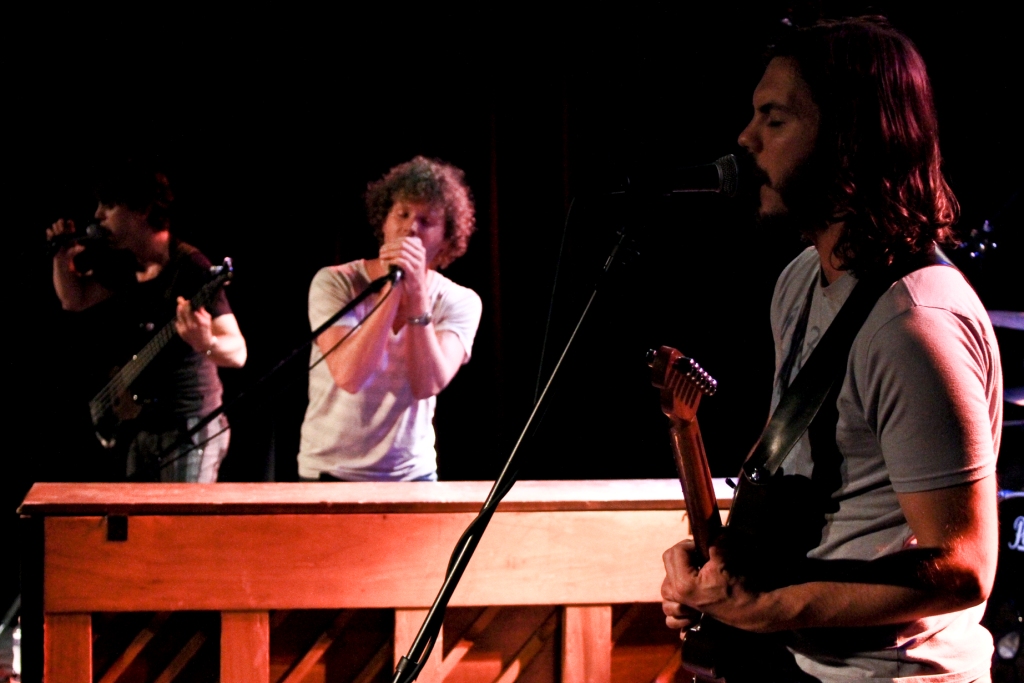
Photo, Jamie McCormick - courtesy briterevolution.com
– Brad Hardisty, Nashville, TN thenashvillebridge@hotmail.com





 The Nashville Bridge